Monster Truck Go: Kids Racing
- 4.3
- Rating
- 10.00M
- Installs
- Free
- Price
 Analysis by App-foxy
I approached Monster Truck Go: Kids Racing as a game for younger players rather than as a serious racing simulator, and that distinction matters from the first race. It is a colorful off-road driving game from Yateland Games for kids, built around short, approachable events and oversized vehicles that are easy to understand. My overall impression is that it works best as a simple pick-up-and-play experience for children who enjoy trucks, jumps, and bright environments, while adults looking for realistic handling or deep vehicle tuning will quickly find it too light.
The game is free to start, carries an Everyone age rating, and runs on devices using Android 8.0 or later. Its current version is 1.3.6, and the game has reached over ten million installs with an average rating of 4.3 from roughly forty-nine thousand ratings. Those figures suggest that it has found a substantial audience, but they do not change the central question for a parent: does the actual play style suit the child who will use it?
How the current version feels to play
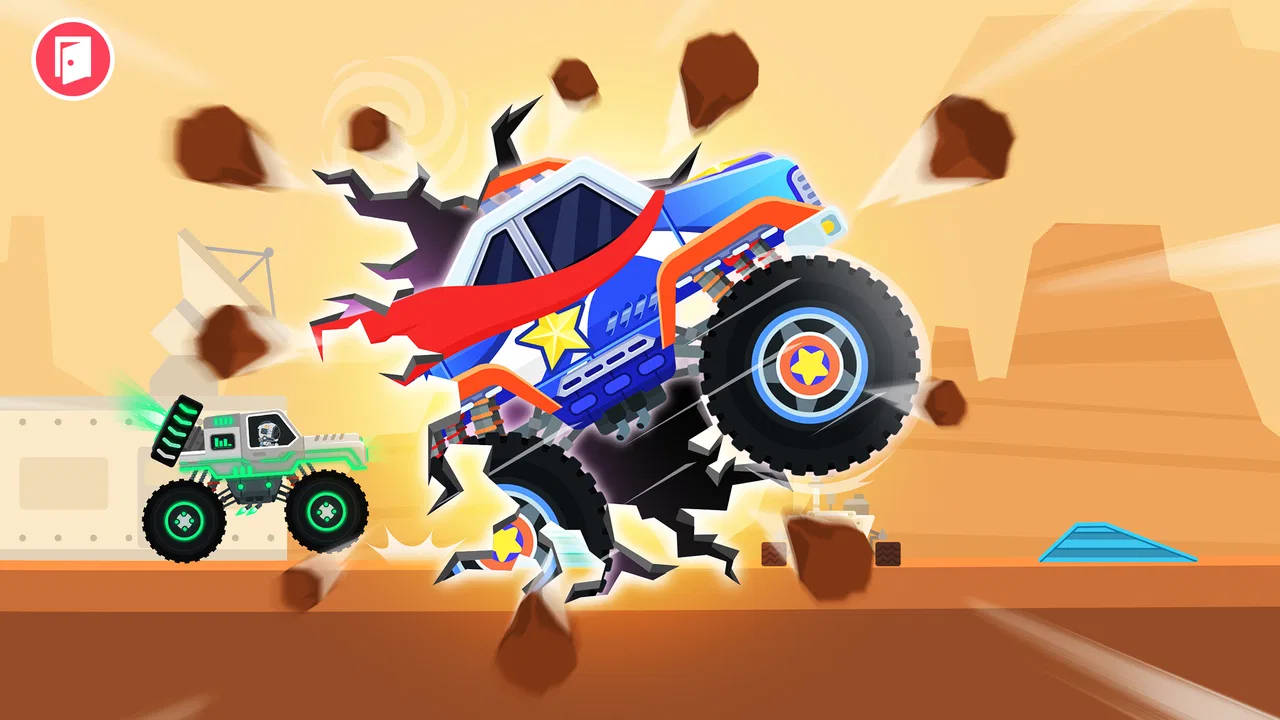
The basic appeal is immediate. You choose a monster truck, enter an off-road course, and concentrate on getting through the route without losing control. The presentation is designed to make the action readable, not intimidating. Large vehicles, exaggerated terrain, and a clear racing premise give a child something they can understand without needing a long explanation.
You May Also Like

 Blood Strike: 2.5 Anniversary
Blood Strike’s Loadouts Turn Every Drop Into a Tactical Gamble
A close look at Blood Strike’s custom loadouts: how fast access to signature weapons reshapes its battle royale rhythm, rewards preparation, and narrows the gap between fights.

 Pandora - Music & Podcasts
Pandora’s Music Is Easy to Start, but Harder to Recover
Pandora’s strength is its low-effort path from a seed to a station. Its weak spot is how much confidence it asks you to place in connection, setup, and quiet recovery.

 8 Ball Pool
 Is Built on Rivalries, Rematches, and Routine
A close look at the rivalries, rematches, shared routines, and unanswered safety questions that turn a quick pool match into a persistent mobile community.

 Samsung Music
’s Quiet Strength Is Playing What You Already Own
Its reach comes less from spectacle than from dependable access to a personal library. That simplicity is both the app’s strongest retention engine and its ceiling.

 AccuWeather: Weather Radar
AccuWeather Review: A Quick, Clear Forecast for Everyday Decisions
For everyday plans, the best forecast is the one you can understand quickly. AccuWeather makes rain timing, radar, and local conditions easy to act on, with a few trade-offs.

 Hill Climb Racing
Why Hill Climb Racing Still Turns Crashes Into One More Run
A tiny car, a bumpy hill and one more upgrade: Hill Climb Racing keeps resurfacing because its simple chaos makes every near-miss feel personal.
More From Our News Desk



I found the short-race format especially useful for everyday play. A child can play for a few minutes while waiting at a restaurant, during a short journey, or between other activities without needing to remember a complicated campaign structure. That convenience is one of the strongest reasons to consider it. It is not trying to replace a full console racer; it is closer to a cheerful driving toy that happens to organize its play into races.
The store summary describes one hundred and fifty monster trucks across twenty off-road worlds. I would treat that as the scale of the content rather than a promise that every vehicle will feel radically different. For a young player, the sense of collecting and moving through varied locations can be motivating on its own. For an older child, the repeated driving pattern may become familiar sooner, particularly if they expect every truck to handle in a noticeably unique way.
The controls are the part I would pay closest attention to before handing over the phone. Young players generally need controls that respond predictably, and a racing game can become frustrating when steering, acceleration, or recovery from a jump feels difficult to understand. This title is most comfortable for children who enjoy experimenting and do not need perfect results on every attempt. If a child becomes upset whenever a vehicle flips or misses a section, an adult may need to sit with them during the first few sessions.
A better way to introduce it to a child
I would not begin by presenting the game as a competition that must be mastered. Instead, I would let the child explore the driving rhythm first: accelerate, steer, watch the truck move over uneven ground, and learn what happens after a mistake. That approach turns early failures into part of the play rather than a test they are expected to pass immediately.
There is also a practical benefit to keeping the first session short. A child can try several races, decide which trucks and environments they enjoy, and then stop before the novelty wears off. Returning later makes the large amount of content feel more manageable. In my experience, this works better than encouraging a child to push through every available event in one sitting.
One non-obvious strength is that the oversized truck theme gives the game a forgiving emotional tone. A small mistake feels like part of the cartoon action rather than a serious crash. That matters for younger players who are still learning how touch controls behave. The vehicle is visually prominent, so the child can focus on the relationship between movement and the course instead of trying to interpret a crowded racing interface.
What the content scale means in practice
The number of trucks and worlds sounds generous, but quantity alone does not guarantee long-term variety. The real value depends on whether the player enjoys repeating the central loop: choosing a truck, tackling an off-road route, and trying again. Children who like collecting, unlocking, or simply seeing new scenery may stay interested for a long time. Those who need elaborate story progression, multiplayer competition, or detailed customization may not.
This is where the game differs from many mainstream racing alternatives. A conventional mobile racer often emphasizes licensed cars, realistic tracks, upgrades, or competitive leaderboards. Monster Truck Go: Kids Racing instead makes the vehicle itself the star and keeps the fantasy broad and playful. That makes it more approachable for a young audience, but it also means there is less here for someone who wants to compare lap times, tune suspension, or build a detailed garage.
How the game has developed
The release history places the game in the mobile catalog since March 14, 2017, while the current version is 1.3.6. That combination tells me the product has had time to settle into its identity rather than appearing as a brand-new experiment. I would expect a mature, established experience here: a straightforward children’s racing game with its main appeal already clearly defined.
I would be careful, however, not to treat a version number as proof of a particular feature or improvement. The useful conclusion is more modest: the game is currently maintained under a later version than its original release, so anyone installing it today should use the current build rather than judging it solely by impressions from its early years. The important thing for a new player is how the present version performs on their device and whether the available content fits their expectations.
For existing users, an updated build can be reassuring because it means the game has not remained frozen at launch. At the same time, long-term players should not assume that a newer version transforms the game into a different genre. Its core remains a child-friendly monster-truck racer. If someone already enjoys that loop, the current release should feel like the same familiar product in its established form; if they wanted a deeper simulation, a version update is unlikely to solve that mismatch.
Free access and the family decision
The game is listed as free, but it includes in-app purchases ranging from ninety-nine cents to twelve dollars and ninety-nine cents per item. That is the detail I would discuss with a parent before installation. Free entry makes it easy to test the experience without committing money immediately, yet a child may still encounter reasons to ask for additional content or purchases during play.
I would recommend setting expectations before the first race. Explain whether the child may use only the free portion, whether purchases require permission, and what to do if a purchase screen appears. This is not just a financial precaution; it also prevents an otherwise enjoyable session from turning into an argument. The game’s Everyone rating describes its audience, but it does not replace a parent’s judgment about spending and supervision.
The purchase range also affects how I compare it with paid children’s games. A single upfront purchase can feel simpler for families that want a clearly bounded experience. On the other hand, free access is useful when you are unsure whether a child will enjoy monster-truck racing at all. I would start with the free version, observe how naturally the child returns to it, and only then decide whether any optional spending makes sense.
Where it fits into an ordinary day
Imagine a child waiting for an appointment with a phone or tablet in hand. This game is a reasonable choice when the goal is a contained activity that can be paused after a race. The bright truck theme gives the child an immediate objective, and the off-road setting is more imaginative than a plain driving test. It can also work during a quiet afternoon when a child wants independent play but is not ready for a complex racing game.
I would be less likely to choose it for a long trip if the child expects a constantly changing adventure. Repetition can become noticeable when the player has already learned the basic rhythm. In that situation, I would alternate it with a drawing app, a puzzle game, or a different type of racing experience rather than relying on it as the only source of entertainment.
Another useful scenario is shared play between an adult and a child. The adult does not need to understand a complicated upgrade system to participate. You can talk about which truck looks fun, predict what will happen on a steep section, or encourage the child to try again after a mistake. That makes the game more suitable for casual guidance than for serious head-to-head competition.
Limitations that should shape your expectations
The biggest limitation is depth. The game’s appeal comes from accessible driving and a large collection of trucks and worlds, not from realistic physics or advanced strategy. If your child is already comfortable with demanding racing games, they may find the handling and progression too simple. Older players may also notice that the same basic actions remain central even as the scenery changes.
There is a second trade-off between accessibility and precision. A forgiving children’s racer is easier to enter, but it may not provide the exact feedback that experienced players want. A serious racing fan usually expects careful braking, detailed cornering, and meaningful differences between vehicles. I would choose a more advanced alternative for that audience rather than hoping this game will gradually become a simulator.
The purchase system is another point of friction, especially for families who prefer completely purchase-free children’s software. The game can still be useful as a free trial, but parents should remain involved in deciding whether optional items are appropriate. If your priority is a fully predictable cost from the moment of installation, a paid alternative may be a better fit.
Device compatibility is reasonably broad for newer phones and tablets because the minimum operating system is Android 8.0. Still, compatibility on paper is not the same as comfort in use. Older hardware may offer a less pleasant experience than a recent device, and young children are less tolerant of delayed touch response or awkward screen size. I would test it on the actual device the child will use before making it their regular game.
Who should play it, and who should skip it
I would recommend it to younger children who are drawn to monster trucks and enjoy simple racing challenges. It is also a good candidate for parents seeking a free starting point rather than a complex purchase. The Everyone rating, clear theme, and short-session structure make it easy to understand why it might work in a family setting.
I would skip it for anyone seeking online competition, realistic motorsport, deep vehicle configuration, or a strong narrative campaign. I would also look elsewhere if the child loses interest quickly when the main activity repeats. The large selection of trucks and worlds helps with variety, but it does not change the fundamental kind of game this is.
Compared with an arcade racer aimed at a general audience, this title is less demanding and more visually direct. Compared with a preschool activity app, it offers more movement and goal-oriented play. That middle position is its real niche: it is more active than a passive toy app, but much less complicated than a conventional racing game.
What I would watch after installing
My first check would be whether the child understands the controls without constant adult correction. If they can begin experimenting and recover from mistakes, the game is doing its job as an accessible racer. If every course becomes a struggle with steering or timing, the problem may not be the child’s ability; the game may simply not match their preferred level of challenge.
Next, I would watch how the child uses the available content. Do they enjoy trying different trucks, or do they settle on one and ignore the rest? Do new worlds renew their interest, or do they ask for a different game after a few races? These observations tell you more than the headline content count because they reveal whether variety is meaningful for that particular player.
I would also monitor purchase requests and screen habits. A free game can be perfectly reasonable when used with clear boundaries, but it should not quietly become an open-ended spending channel or the default activity for every idle moment. Short sessions, occasional shared play, and a simple rule about purchases make the experience easier to manage.
Finally, I would keep an eye on future versions without assuming that every update will expand the game’s depth. The current release is best judged on what it already offers: child-focused off-road racing, a broad selection of trucks and worlds, and a low barrier to entry. Expectations should remain grounded in that identity rather than in hopes that it will eventually compete with advanced racing titles.
My final view is positive but specific. This is a good choice when you want approachable monster-truck racing for a young player, not when you want a full racing simulation. I like the clear theme, the easy-to-understand premise, and the way a short race can fit into an ordinary family day. I would install it as a free trial, introduce it with sensible purchase rules, and let the child’s response determine whether it earns a permanent place on the device.
For the right audience, the game offers cheerful, uncomplicated driving with enough trucks and locations to encourage exploration. For everyone else, its simplicity and in-app purchase structure may become more noticeable than its charm. That is why my recommendation is conditional: if your child loves monster trucks and prefers accessible play, Monster Truck Go: Kids Racing is worth trying; if they want competition, realism, or deep progression, choose a more advanced racing game instead.
FAQs for Monster Truck Go: Kids Racing
01What is Monster Truck Go: Kids Racing?
Monster Truck Go: Kids Racing is a colorful, child-friendly driving game designed around simple monster-truck races and playful challenges. Players choose a truck, drive through bright tracks, collect items, and overcome ramps or obstacles while trying to reach the finish line. Its straightforward controls and cartoon presentation make it more suitable for young children than for players looking for realistic racing simulation.
02Is Monster Truck Go: Kids Racing suitable for young children?
The game is designed with children in mind, using large visual elements, simple controls, cheerful graphics, and uncomplicated racing mechanics. Younger players can usually begin playing without needing to understand complicated menus or advanced driving systems. However, parents should still review the app’s age rating, advertising, in-app purchase settings, and privacy information before allowing a child to play independently.
03How does the gameplay and control system work?
Monster Truck Go: Kids Racing focuses on accessible gameplay rather than technical driving. Depending on the track and device version, players generally use on-screen buttons or simple touch controls to accelerate, steer, jump, and keep the truck balanced. The forgiving design helps children recover from mistakes, although the experience may feel too basic for older players who prefer precise handling or competitive racing mechanics.
04Does Monster Truck Go: Kids Racing require an internet connection?
The core racing experience may be playable without a continuous internet connection, which is convenient for travel or for children using a tablet away from Wi-Fi. Nevertheless, some features can depend on connectivity, including advertisements, updates, analytics, optional purchases, or downloading additional content. Because requirements can change between versions, it is best to test the installed game in offline mode before relying on it without internet access.
05Are there advertisements or in-app purchases in the game?
Parents should check the current store listing and the in-game settings because monetization can vary by platform, region, and version. Free children’s racing games may display advertisements or offer optional purchases such as removing ads, unlocking trucks, or accessing extra content. To avoid accidental purchases, use the device’s parental controls, require authentication for payments, and supervise gameplay when the child is using the app.
Pros
- Simple controls are easy for young children to understand.
- Bright monster trucks and colorful tracks keep races visually engaging.
- Short races suit children with limited attention spans.
- Offline play makes it convenient for travel or areas without internet.
- Gentle gameplay avoids complex competition and frustrating difficulty.
Cons
- Repetitive tracks may become boring after several play sessions.
- Limited truck customization reduces long-term replay value.
- Some levels may feel too easy for older children.
- Ads or purchase prompts may interrupt the child’s experience.
- Sound effects can become noisy during extended play.

Monster Truck Go: Kids Racing
Gallery